
The Curiosity Lens
Why parents don't need more judgment. They need a translator.
You have probably heard it more than once.
From a teacher, a doctor, a well-meaning family member, or a professional who assessed your child for twenty minutes and handed you a report.
"Their behaviour is quite challenging."
"They need to focus more."
"They are behind socially."
"They seem to avoid sport."
"They can't sit still."
"Have you tried being more consistent?"
Each piece of feedback lands somewhere in your chest. You carry it home. You add it to the pile of everything else you are already carrying. And somewhere underneath all of it is a question that nobody seems to be answering.
Why? Why is my child like this? And what can I actually do about it?
That question is exactly where we begin.
The pile nobody talks about
Parents of children who are struggling, whether with behaviour, movement, development, regulation, or confidence, often describe the same experience.
They have seen multiple professionals. They have received multiple opinions. They have been told to wait and see, to try harder, to be more patient, to push more, to push less. They have sat in waiting rooms filling out questionnaires that ask about milestones but never ask about the child in front of them.
What they have not been given is a framework. A way of connecting the dots between what they are observing at home and what the professionals keep describing in their reports.
Because here is the thing. The teacher who says your child can't focus, the GP who says they are behind socially, and the coach who says they avoid the ball, they are all describing the same child. They just don't know that yet. And neither do you, because nobody has shown you the thread that connects all of it.
That thread is almost always the nervous system. And the place it shows up most clearly is in movement.
What movement actually tells us

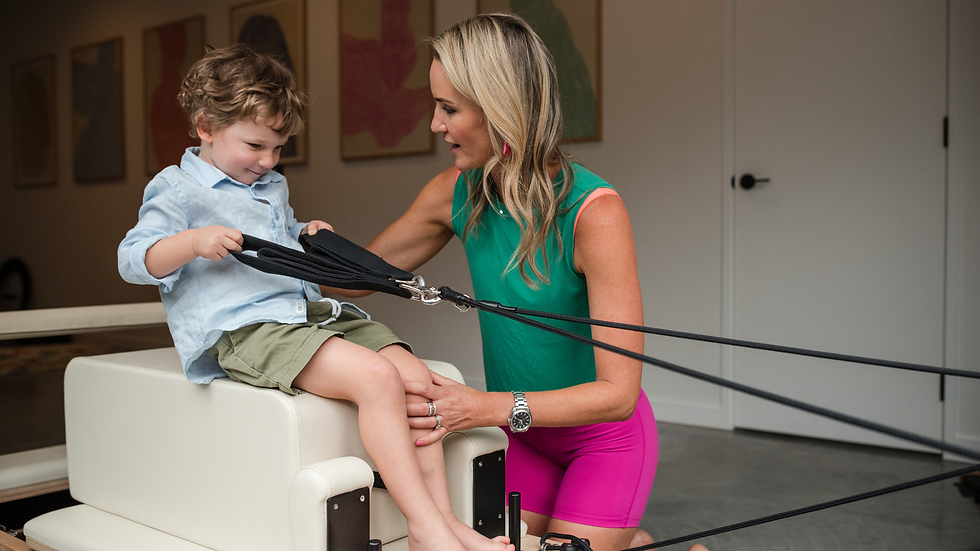
At Kids Heart Pilates, when we watch a child move, we are not watching to see if they can do the task.
We are watching how they approach it.
We are watching whether they pause before attempting something new, or whether they throw themselves in without reading the environment. We are watching how they recover from a mistake. Whether they laugh it off, or whether they shut down completely. We are watching what their body does when they are tired, or frustrated, or overwhelmed.
We are watching the nervous system.
Movement is one of the most honest windows into a child's development that exists. It cannot be masked the way behaviour can. It cannot be performed the way speech and social skills sometimes are. It reveals, in real time, what is actually happening for a child.
Movement is not just about what the body can do. It is about what the body is communicating.
And what it communicates includes far more than most people realise. Through movement, we can see:
How a child regulates their nervous system under pressure
Their sensory processing, and whether they are seeking or avoiding input
Their postural endurance, which directly affects their ability to sit, attend, and learn
Their bilateral coordination, which underpins reading, writing, and crossing the midline
Their motor planning, or how well their brain organises the body to complete a sequence
Their confidence, and whether they have learned that movement is a place where they fail
Their emotional safety, and whether they trust an adult to guide them without judgment
Their cognitive load, and whether the task demands exceed what their system can hold
Their social engagement, and how they navigate shared physical space with peers
That is a lot of information from one session. It is also why we describe ourselves not as exercise instructors, but as movement clinicians. What we observe in a session shapes everything we do next.
The curiosity lens
There is a way of looking at a child that begins with what is wrong with them. It starts with the deficit. The delay. The diagnosis. The gap between where they are and where they "should" be.
That lens is everywhere. It is in the school report. The referral letter. The intake form. It is well-intentioned, but over time, it shapes how the child sees themselves.
We use a different lens.
We call it the curiosity lens. Instead of asking what is wrong, we ask what is happening. Instead of measuring what a child cannot do, we observe what their body is trying to communicate. Instead of responding to behaviour with correction or consequence, we respond with a question.
What is this behaviour trying to tell me? What does this child need that they are not currently getting?
That shift changes everything. It changes the session. It changes the relationship. And over time, it changes the child's experience of themselves in movement.
Because most children who avoid sport, struggle in groups, or melt down at the end of the school day are not doing it on purpose. They are doing it because their nervous system is doing its job. It is protecting them from something that feels overwhelming, unpredictable, or unsafe.
The curiosity lens lets us see that. And once you can see it, you can actually help.
What behaviour is usually communicating
We see a lot of behaviours in our sessions that parents have been told are problems. And in most cases, when we look beneath the behaviour, there is a very logical explanation.
The child who crashes into things is often seeking proprioceptive input. Their nervous system is under-registering sensation and searching for feedback through impact. It looks like "naughtiness." It is actually a sensory need that has not been identified or met.
The child who refuses to cross the monkey bars is sometimes showing us poor bilateral integration or a fear response around vestibular input. The avoidance looks like stubbornness. It is often a nervous system that does not yet have the skill or the safety to attempt the task.
The child who melts down at 4pm every afternoon, the one who was "fine" at school all day, is often showing us the cost of six hours of regulation. They held it together. They managed the noise, the transitions, the social demands, the sensory load. And when they walked through the door and felt safe enough, they let it go. That is not bad behaviour. That is a child who worked incredibly hard all day and ran out of capacity.
The child who makes jokes when they get something wrong is often protecting themselves from the unbearable feeling of failure. The humour is a shield. Beneath it is usually a child who cares deeply about getting things right and has not yet learned that imperfection is survivable.
The child who cannot sit still during a task is sometimes showing us poor postural endurance. The core muscles that are meant to hold the body upright without effort are working so hard that there is nothing left for attention. The fidgeting is not deliberate. It is the nervous system trying to find the input it needs to function.
There is almost always a reason beneath the behaviour. Finding it is not about making excuses. It is about understanding what the child actually needs.
The invisible load parents carry
We want to say something to the parents who are reading this.
We see you.
We see the comparing, even when you know you shouldn't. The looking at other children at the park and wondering why your child finds it so hard. The sitting in the car outside school, bracing for what the afternoon is going to bring.
We see the dismissed feelings. The professionals who told you not to worry. The family members who said you were overthinking it. The waiting lists that make you feel like by the time you get help, it will be too late.
We see the conflicting advice. The recommendations that contradict each other. The sense that you are supposed to just know what the right thing is, and the guilt that comes when you don't.
We see the love. The extraordinary, exhausting, relentless love that underpins every question you are asking and every appointment you are making and every night you lie awake wondering if you are doing enough.
You are doing enough. You are doing more than enough. You just need someone who can help you understand what you are looking at.
That is what we are here for.
What it looks like when we translate

A family came to us recently. Their child, seven years old, had been described across three different reports as having attention difficulties, low social confidence, and challenges with gross motor coordination.
What the reports didn't connect was this. The attention difficulties were showing up most in sitting tasks. The social confidence dropped significantly in unstructured physical environments, like the playground. The gross motor challenges included a very specific pattern of avoiding tasks that crossed the body's midline.
When we put those pieces together, we could see a child whose postural endurance meant that sitting was effortful and distracting. A child whose bilateral integration made certain movements feel unreliable, which made physical environments feel unpredictable. A child who had learned, over time, that moving in front of other children usually meant doing something in a way that looked different from everyone else.
The reports described what the child couldn't do. We could see why, and more importantly, where to begin.
We started with movement that felt safe and achievable. We built postural strength gradually, without making the child aware it was the goal. We introduced bilateral activities through play, not exercise. We let the child lead the pace.
Three months later, the teacher noted that the child was sitting more comfortably, engaging more confidently in group activities, and had started joining games at lunch that they had always avoided.
Nothing about that child had changed. What changed was that someone finally had a framework for understanding what they needed.
Movement supports more than the body
We want to be clear about something, because it matters.
What we do at Kids Heart Pilates is not exercise for the sake of fitness. It is movement as a clinical tool.
Movement regulates the nervous system. It reduces cortisol. It provides the proprioceptive and vestibular input that many children are actively seeking. It builds the postural foundations that underpin attention, learning, and social engagement. It creates experiences of success in environments that have often felt unsafe.
When a child experiences movement as something that is designed around them, that adapts to where they are, that never asks them to perform beyond what they can actually manage right now, something shifts.
Confidence is not built through success alone. It is built through the experience of being held steady while you try something difficult. Of having someone alongside you who is not watching for failure, but watching with curiosity.
That is what a good movement session provides. And over time, it is remarkable what changes.
Children who avoided sport start asking to try new activities.
Children who melted down at transitions begin to show more flexibility.
Children who struggled to make friends in physical settings start to find their place in the group.
Children who believed they were bad at everything physical begin to have a different story about themselves.
None of that happens because we pushed harder or held higher expectations. It happens because we looked at the child in front of us with curiosity, and built from there.
Where we start
When a family comes to Kids Heart Pilates, we do not begin with a checklist of what their child cannot do.
We begin with questions. What does your child love? What environments feel hard for them? What does the end of a school day usually look like? What have you noticed that doesn't quite fit the explanations you have been given?
We begin with the parents, because parents are the experts on their child. We may have clinical training. But they have been watching this child every single day. They have seen the patterns that the reports miss. They have noticed the things that happen in the kitchen at 5pm that nobody else ever sees.
Our job is to take what they know, and what we observe, and put it together into a picture that makes sense. Then to translate that picture into something the family can work with. Not a list of deficits. Not a diagnosis without direction. A framework for understanding, and a clear place to begin.
We are not here to tell you what is wrong with your child. We are here to help you understand what they are communicating, and how to respond.
A note to parents who are still figuring it out
If you have been feeling for a while that something is going on with your child, something you can't quite name or prove or explain to other people, trust that feeling.
Parents notice things before anyone else does. The patterns you have been watching are real, even when they are hard to articulate. The instinct that there is something more happening beneath the surface, that is almost always right.
You don't need to have a diagnosis to come and see us. You don't need a referral. You don't need to have the right language or the right reports or a neat summary of your child's challenges.
You just need to show up. We will take it from there.


The article highlights the vital connection between children's behavior and their nervous system, specifically through movement. It asserts that understanding this relationship is crucial for effective intervention. The mention of Leon https://simplicityfunds.kiwi/ as a case study emphasizes the need for a holistic view rather than solely focusing on deficits. Ultimately, this perspective could reshape how we address children's challenges and support their growth.
This article presents a compelling case for reevaluating how we understand children's behaviors through the lens of their nervous systems. It highlights the need for a framework that connects various observations, rather than viewing them as isolated issues. The concept of using movement as a key insight into a child's development is intriguing. It mirrors concepts from various therapeutic practices, much like the approach taken by Royal Reels https://whatelse.io/ in their innovative strategies. Understanding the underlying mechanisms allows for a more holistic view of a child's needs and potential.
This article presents a compelling perspective on understanding children's behavior through the lens of their nervous system and movement. The emphasis on the curiosity lens is particularly insightful. It suggests that traditional methods often overlook critical aspects of a child's experiences. However, there remains a need for balancing this approach with structured assessment frameworks, especially when utilizing tools like Pay ID https://payidcasinos.eu.com/ for payment processing in therapeutic settings. How can we ensure that these innovative methods reach more families effectively?
This article sheds light on a crucial aspect of child development that often goes unnoticed. The emphasis on understanding a child through the lens of their movement is insightful. Many parents struggle with the feedback they receive, like the notion that their child's behavior is challenging. It’s essential to recognize that the way they move may reveal their emotional and nervous system state. The approach you advocate, using the curiosity lens, could indeed transform how we perceive challenges. In a society obsessed with labels, Ozwin offers a refreshing perspective that prioritizes understanding over judgment.
This article raises critical issues regarding how children are assessed and understood in therapeutic contexts. It highlights the disconnect between professionals and parents, where the underlying patterns often remain obscured. The emphasis on "The Pokies https://www.roaringmegs.co.nz/ " method represents a shift from deficit-based perspectives to a more curious and integrative approach. This change could foster deeper understanding and support for children, promoting more meaningful progress.